

In today’s healthcare landscape, patient privacy and regulatory compliance are paramount. As hospitals and healthcare providers increasingly adopt digital technologies, the responsibility to protect sensitive patient data grows exponentially. Hospital CRM systems sit at the intersection of operational efficiency and data security: they centralise patient data, streamline communication, and manage engagement workflows, but they also become a primary custodian of Protected Health Information (PHI).
A hospital CRM that cannot demonstrate AES-256 encryption, role-based access control (RBAC), comprehensive audit trails, and automated HIPAA compliance checks is a liability, not an asset. This guide explains the security architecture that separates compliant CRM platforms from the rest, covers HIPAA and GDPR requirements in detail, and walks through real-world deployments where hospitals achieved zero breaches and measurable cost reductions.
Security Architecture at a Glance
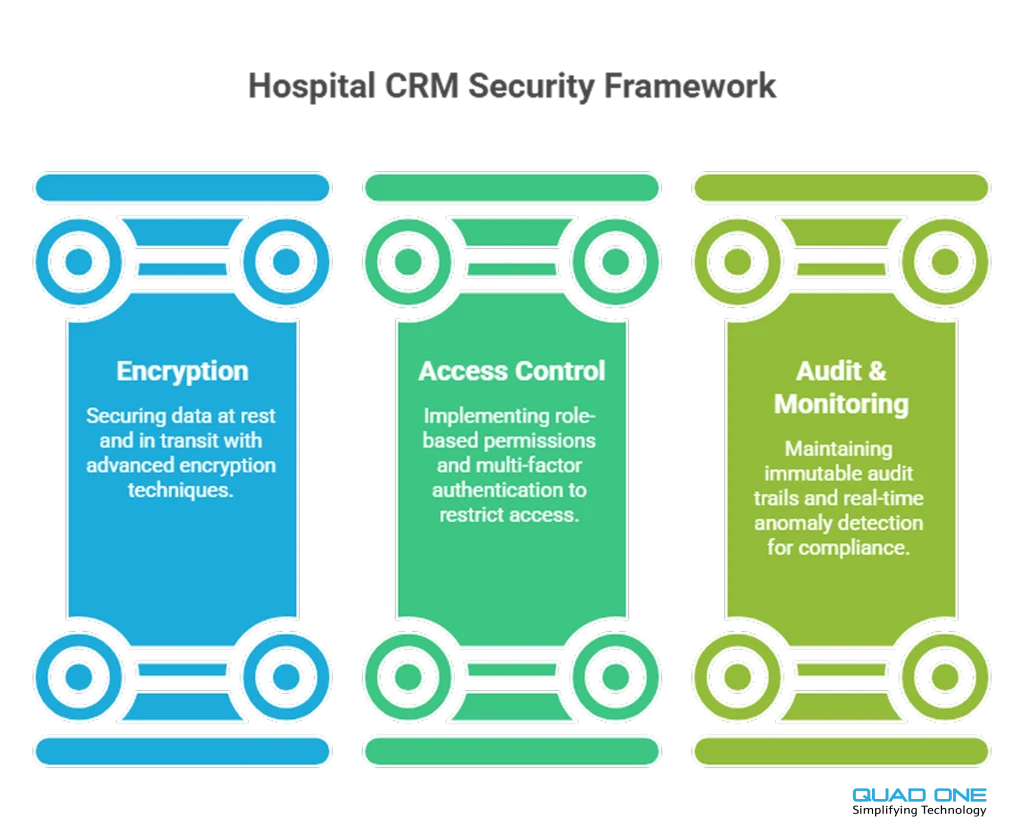
A HIPAA-compliant hospital CRM delivers: AES-256 encryption for data at rest and TLS 1.2+ for data in transit; role-based access controls limiting PHI visibility to authorised personnel only; immutable audit trails logging every access, modification, and export; automated compliance checks against HIPAA, GDPR, and state-level regulations; consent management surfacing patient preferences at the point of communication; and a signed Business Associate Agreement (BAA) with the CRM vendor. One US provider achieved zero data breaches and a 25% reduction in administrative compliance costs after deploying a HIPAA-compliant CRM with these capabilities.
How Does Hospital CRM Protect Patient Privacy?
Healthcare CRM systems are specifically designed to help hospitals and clinics manage patient relationships efficiently. But their importance goes beyond operational efficiency. They are vital tools in ensuring patient privacy. Here are the core privacy-protection mechanisms built into a compliant hospital CRM.
AES-256 Data Encryption
One of the most critical features of a healthcare CRM for patient privacy is data encryption. Healthcare CRMs use AES-256 encryption to safeguard sensitive patient information. This encryption ensures that data remains unreadable during transmission (in transit, protected by TLS 1.2 or higher) and when stored on servers (at rest). Even if unauthorised individuals gain access to the data, they cannot decipher it without the correct decryption keys. AES-256 is the industry gold standard, providing a level of protection that is practically unbreakable with current computing technology.
Role-Based Access Control (RBAC)
RBAC ensures that only authorised personnel can view or modify specific categories of patient data. A front-desk coordinator sees scheduling information but not clinical notes. A billing specialist accesses financial records but not diagnostic reports. A physician sees the full clinical record. This “minimum necessary” principle, mandated by HIPAA, is enforced at the system level, not left to individual judgment.
RBAC also extends to communication: a CRM should surface consent status at the moment of send, preventing a staff member from messaging a patient who has opted out of a specific channel. This mechanism not only supports patient privacy but also facilitates better compliance with HIPAA requirements.
Strong access controls are also foundational to improving patient experience through hospital CRM — patients who trust that their data is secure are more willing to engage with digital communication channels, complete pre-visit forms, and share feedback.
Audit Trails and Continuous Monitoring
Hospital CRM maintains audit trails that record every access or modification made to patient data. These logs capture who accessed the data, when they did it, what changes were made, and from which device or location. Continuous monitoring helps identify unauthorised access, misuse, or potential threats, ensuring that healthcare organisations can respond quickly to resolve security issues.
Audit logs also provide a transparent and traceable record for compliance purposes. Hospitals can produce these logs during HIPAA audits to demonstrate adherence to regulatory standards and protect against fines. Under the 2026 HIPAA rule updates, the Office for Civil Rights (OCR) will focus on verifiable technical implementation rather than policy documentation, making functioning audit systems more important than ever.
How Does Hospital CRM Ensure HIPAA Compliance?
The Health Insurance Portability and Accountability Act (HIPAA) is one of the most stringent regulations governing patient privacy and data protection in the US. A hospital CRM ensures HIPAA compliance through several integrated mechanisms.
Automated Compliance Checks
A HIPAA-compliant CRM automates the verification of regulatory requirements across every patient interaction. Before a message is sent, the system checks consent status, communication channel permissions, and PHI exposure levels. Non-compliant actions are blocked before they happen, not flagged after the fact. This is automated policy enforcement, not manual checklist management.
Business Associate Agreement (BAA)
Any CRM vendor that stores, processes, or transmits PHI on behalf of a hospital must sign a BAA. This legally binding agreement defines the vendor’s responsibilities for safeguarding patient data, specifies permissible uses and disclosures, sets breach notification timelines, and establishes subcontractor obligations. Without a signed BAA, the CRM platform is not legally permitted to handle PHI. This is a non-negotiable threshold in vendor selection.
HIPAA Privacy, Security, and Breach Notification Rules
The CRM must address all three HIPAA rule categories. The Privacy Rule governs how PHI can be used and disclosed, requiring minimum-necessary data access and patient rights management. The Security Rule mandates technical safeguards (encryption, authentication, audit controls, integrity controls, transmission security) for electronic PHI. The Breach Notification Rule requires timely notification to affected individuals and HHS if a breach occurs, making detection and incident response capabilities essential CRM features.
2026 HIPAA Rule Updates
Starting in late 2026, all healthcare organisations must implement verifiable technical safeguards rather than simply documenting policies. Encryption at rest and in transit becomes explicitly mandatory (not just “addressable”). MFA becomes required for all systems accessing ePHI. Annual penetration testing, biannual vulnerability scans, and quarterly backup restoration tests are now required compliance activities. Hospital CRMs must be built to meet these enhanced standards.
How Does Hospital CRM Ensure GDPR Compliance?
For hospitals operating in or serving patients from the European Union, the General Data Protection Regulation (GDPR) adds a second compliance layer on top of HIPAA. A GDPR-compliant hospital CRM must address explicit consent management, data subject rights (access, rectification, erasure, portability), data processing agreements with all third-party processors, privacy-by-design architecture, and Data Protection Impact Assessments (DPIAs) for high-risk processing activities.
In practice, this means the CRM must capture and store explicit patient consent for each category of data processing, allow patients to view, export, or request deletion of their data through self-service or staff-assisted workflows, and maintain records of processing activities that demonstrate compliance to supervisory authorities.
For hospitals using messaging platforms to communicate with patients, GDPR and HIPAA compliance extends to every channel. See how patient data privacy in WhatsApp-based healthcare communication is managed through end-to-end encryption, consent tracking, and dual-layer protection systems.
How Does Hospital CRM Improve Efficiency While Maintaining Security?
Security and operational efficiency are not trade-offs in a well-architected hospital CRM. They are mutually reinforcing.
Automated appointment scheduling and reminders operate through encrypted channels, reducing missed appointments while maintaining HIPAA-compliant communication. The CRM checks consent and channel preference before every send.
Centralised patient data means clinical, scheduling, billing, and communication records are stored in a single, encrypted repository with RBAC. Staff spend less time searching across disconnected systems, and every access is logged.
EHR integration via FHIR APIs ensures that data flows securely between clinical and engagement systems without manual re-entry or unencrypted exports. The CRM reads from and writes to the EHR through standardised, auditable interfaces.
AI-powered anomaly detection identifies unusual patterns in patient data access (after-hours queries, bulk exports, access from unfamiliar devices) and alerts IT teams in real time. Machine learning algorithms continuously learn from past security events, improving the system’s ability to predict and prevent future threats.
Telehealth integration extends these security controls to remote consultations. Hospital CRM systems ensure that voice, video, and messaging interactions remain encrypted and compliant whether the patient is in the facility, at home, or on a mobile device.
What Do Real-World Hospital CRM Compliance Deployments Look Like?
US Healthcare Provider: Zero Breaches, 25% Cost Reduction
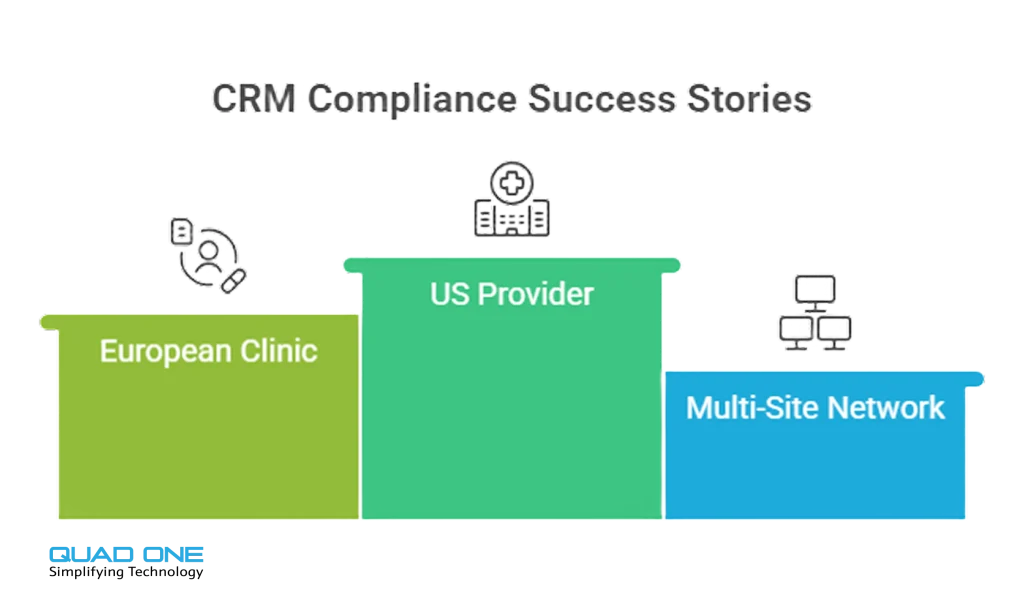
A US-based healthcare provider implemented a HIPAA-compliant CRM to centralise patient data, streamline communication, and automate compliance checks. The CRM’s automated compliance engine ensured that every patient interaction adhered to HIPAA standards without manual review. Audit trails provided full transparency during regulatory audits. The result: zero data breaches since deployment and a 25% reduction in administrative compliance costs.
European Clinic: GDPR-Compliant Patient Data Management
A European clinic integrated a healthcare CRM for patient privacy, ensuring compliance with GDPR. The CRM allowed the clinic to store patient data securely while managing explicit consent forms for data processing. Patients could access, modify, or request deletion of their data through a self-service portal. The clinic passed its GDPR supervisory authority audit with no findings.
Multi-Site Hospital Network: Telehealth + CRM Security
Hospital CRM is increasingly integrated with telemedicine platforms and remote monitoring technologies, enabling healthcare providers to securely manage patient interactions and data remotely. One multi-site network deployed a CRM that maintained HIPAA-compliant security across in-person, phone, and virtual consultation channels. Encrypted communication, consent verification, and audit logging operated identically regardless of modality.
How Does Hospital CRM Manage Patient Consent?
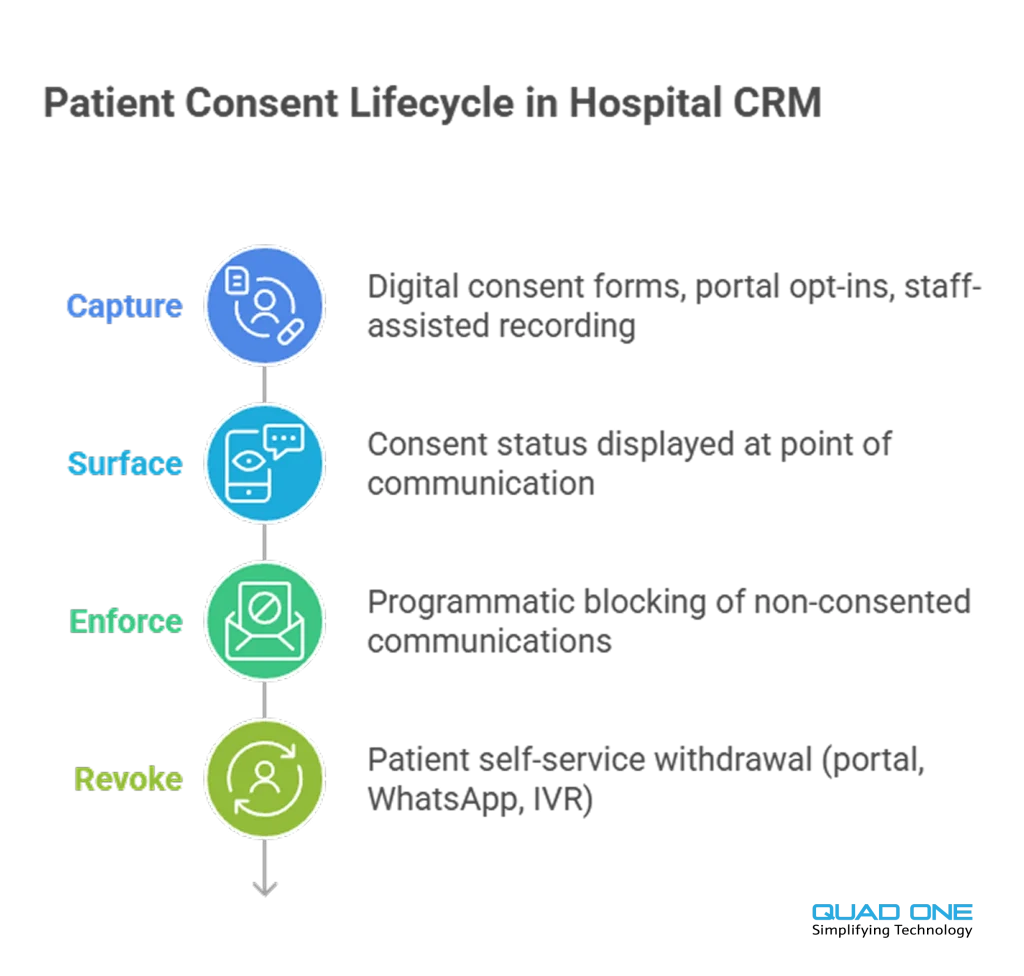
Patient consent management is a critical but often under-architected capability. A compliant hospital CRM must capture, store, surface, and enforce consent preferences across every communication channel and data processing activity.
Capture: The CRM records explicit consent for each category (appointment reminders, marketing, research, data sharing) through digital forms, patient portal opt-ins, or staff-assisted workflows. Consent records include timestamp, method, and scope.
Surface: At the moment a staff member or automated workflow initiates a patient communication, the CRM displays the patient’s current consent status for that specific channel and purpose. Non-consented sends are blocked.
Enforce: The system enforces consent rules programmatically. A patient who has consented to SMS appointment reminders but opted out of email marketing will only receive SMS, and only for appointment purposes. No manual override is permitted without a documented clinical justification.
Revoke: Patients can withdraw consent at any time through self-service (patient portal, WhatsApp, IVR) or staff-assisted channels. Revocation takes effect immediately and is logged in the audit trail.
The Future of Privacy and Compliance in Hospital CRM
As technology continues to evolve, healthcare CRM will remain a cornerstone of secure, compliant patient care. Emerging developments include:
AI-powered threat detection that moves beyond rule-based monitoring to behavioural analysis, identifying insider threats and sophisticated attack patterns before a breach occurs.
Zero-trust architecture where every access request is verified regardless of network location, replacing perimeter-based security with continuous authentication.
Privacy-enhancing technologies (PETs) such as differential privacy and federated learning that allow AI models to train on patient data without exposing individual records.
Automated regulatory tracking that updates compliance rules in real time as HIPAA, GDPR, and state-level regulations evolve, ensuring the CRM never falls behind current requirements.
Conclusion
By integrating advanced security features such as AES-256 encryption, role-based access controls, immutable audit trails, and automated compliance checks, healthcare organisations can safeguard sensitive patient data while enhancing operational efficiency. For hospital administrators, compliance officers, and IT managers, investing in a robust, HIPAA-compliant CRM is no longer optional. It is a necessity to protect both patient data and the organisation’s reputation.
Explore Quad One’s AI-powered Hospital CRM — purpose-built for healthcare with HIPAA compliance, AES-256 encryption, RBAC, and audit-ready reporting out of the box.
Book a compliance demo to see how the security architecture works in practice.