
Smart healthcare is evolving quickly, and AI-driven CRM systems are changing how hospitals connect with patients. By combining AI with traditional CRM tools, hospitals can offer more personalized and efficient care. These systems make it easier to manage appointments, send reminders, and respond to patient queries in real time. They also help reduce manual work for staff while improving patient engagement. Overall, AI-powered CRM is helping hospitals create a more connected, responsive, and patient-focused healthcare experience.
Smart Healthcare: The Rise of AI-Driven CRM in Hospitals
Healthcare is becoming smarter as hospitals adopt AI-driven CRM systems. By combining automation with patient data, these tools enable more personalized, timely, and efficient care. They simplify appointment management, improve real-time communication, and reduce staff workload while enhancing patient engagement. Overall, AI-powered CRM is helping hospitals deliver more connected and patient-focused experiences.
What Is an AI Hospital CRM?
An AI Hospital CRM is a modern patient relationship management system that uses artificial intelligence to improve how hospitals interact with patients. Unlike traditional CRM platforms that mainly store patient data and track interactions, AI-powered CRMs go a step further by actively analyzing data, automating communication, and supporting smarter decision-making.
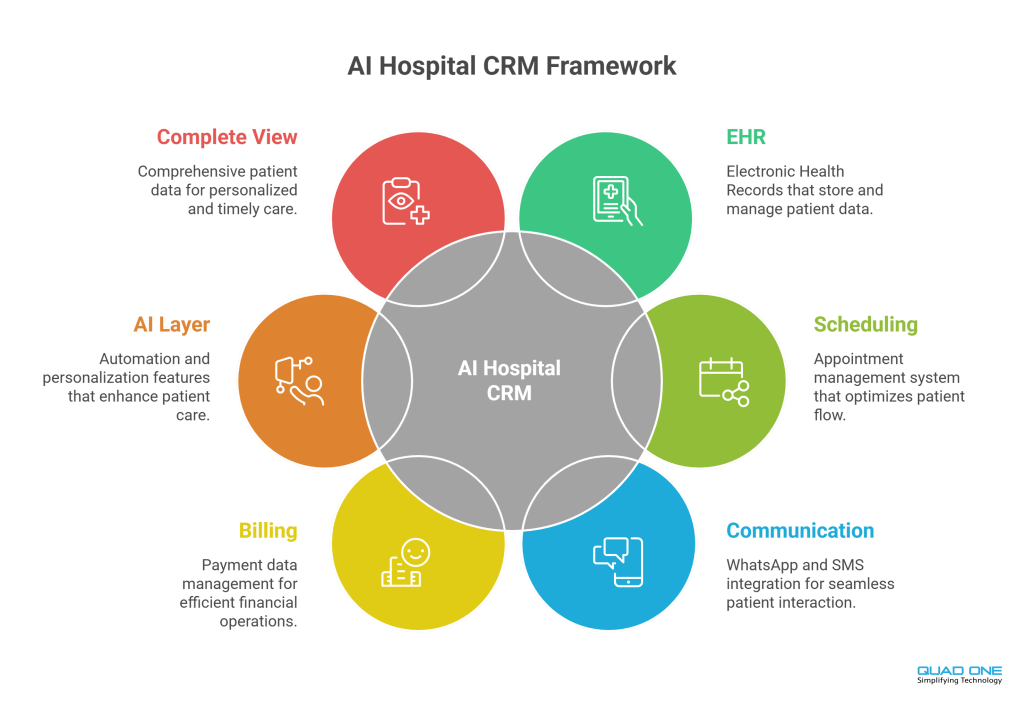
At its core, an AI Hospital CRM connects multiple systems such as Electronic Health Records (EHR), appointment scheduling, billing, and communication channels into one unified platform. This allows hospitals to get a complete view of each patient and deliver more personalized, timely, and efficient care.
With AI integrated into the system, hospitals can automate routine processes like appointment reminders, follow-ups, and patient queries. It also helps staff prioritize tasks, identify patient needs, and improve overall engagement. In simple terms, an AI Hospital CRM doesn’t just manage relationships .It enhances them by making every interaction more intelligent and meaningful.
How Does Generative AI Improve Hospital CRM?
Generative AI is reshaping hospital CRM by making patient interactions more natural, responsive, and efficient, while also taking over time-consuming routine tasks.
Key Benefits
- Personalized patient communication tailored to individual needs and preferences
- Automated responses and follow-ups for faster, consistent engagement
- Intelligent summarization of medical data for quick insights and better decision-making
It also powers conversational tools like WhatsApp bots, allowing patients to book appointments, ask questions, and receive updates instantly making healthcare access simpler, faster, and more intuitive.
What Is the Role of Predictive Analytics in Hospital CRM?
Predictive analytics brings a proactive approach to hospital CRM by helping healthcare providers anticipate patient needs rather than simply reacting to them. By analyzing historical and real-time data, AI can identify patterns and predict future outcomes, enabling hospitals to act at the right time.
For example, predictive models can identify patients who are likely to miss appointments, allowing hospitals to send timely reminders or reschedule in advance. It can also flag patients at risk of readmission or complications, helping care teams intervene early and improve outcomes.
Beyond risk prediction, predictive analytics helps personalize patient journeys. It enables hospitals to recommend the right treatments, follow-ups, and communication strategies based on individual patient profiles. This level of personalization not only improves care quality but also enhances patient satisfaction.
How Will IoT and Wearables Transform Hospital CRM?
The integration of IoT devices and wearable technology is taking hospital CRM to the next level by introducing real-time, continuous patient data into the system. Devices such as fitness trackers, heart rate monitors, and glucose sensors can now collect and transmit health data directly to healthcare providers.
This constant flow of information allows hospitals to monitor patients beyond the clinical setting. Instead of relying only on periodic visits, doctors can track patient health in real time and detect early signs of potential issues. This shift enables a more preventive approach to care.
What Are the Key Challenges of Traditional Hospital CRM?
Traditional hospital CRM systems often struggle to meet the expectations of modern healthcare due to their limited capabilities and lack of flexibility. While they are useful for storing patient data and tracking interactions, they fall short when it comes to delivering personalized and real-time experiences.
One of the biggest challenges is the lack of integration. Many traditional systems operate in silos, making it difficult to access and share data across departments. This can lead to delays, miscommunication, and incomplete patient information.
Another major limitation is the reliance on manual processes. Tasks like appointment scheduling, follow-ups, and data entry often require significant human effort, increasing the risk of errors and inefficiencies.
Personalization is also a weak point. Traditional CRMs typically use generic communication methods that fail to engage patients effectively. In today’s digital world, patients expect timely, relevant, and personalized interactions, which older systems struggle to provide.
How Quad One’s AI Hospital CRM Delivers This Today
While technologies like Generative AI, predictive analytics, and IoT-driven care are often seen as future innovations, Quad One is already bringing these capabilities into everyday hospital operations. Its AI Hospital CRM is designed to make patient engagement more intelligent, proactive, and seamless across every touchpoint.
With built-in Generative AI, hospitals can automate conversations, send personalized messages, and respond to patient queries instantly across channels like WhatsApp, SMS, and email. This ensures consistent communication while reducing the workload on staff. At the same time, predictive analytics works in the background to identify trends such as patients likely to miss appointments or those who may require additional care allowing teams to take timely action.
Quad One also supports integration with connected health systems and wearable devices, enabling real-time data to be part of patient interactions.This helps providers stay informed and deliver more proactive, continuous care. By eliminating manual processes and connecting data across departments, Quad One not only improves efficiency but also enhances the overall patient experience turning what was once a future vision into a practical, everyday reality for modern healthcare providers.
| Aspect | Traditional CRM | AI Hospital CRM |
| Data | Siloed, limited integration | Unified, Integrated data. |
| Communication | Generic, one-way | Personalized, two-way |
| Automation | Mostly manual | AI-driven automation |
| Response Time | Delayed | Instant |
| Personalization | Basic | Advanced |
| Engagement | Reactive | Proactive |
CONCLUSION:
Technologies like Generative AI, predictive analytics, and IoT integration are driving this shift in a meaningful way. Generative AI enables more natural and responsive communication, allowing hospitals to engage with patients instantly and at scale. Predictive analytics helps care teams anticipate patient needs, reduce risks, and take timely action before issues escalate. Meanwhile, IoT and connected devices bring real-time health data into the picture, making care more continuous, proactive, and informed.
By adopting intelligent CRM solutions like Quad One, healthcare providers can bring all these capabilities together into a single, unified system. This not only improves patient engagement through more relevant and timely interactions but also simplifies internal workflows and reduces operational strain. Ultimately, It allows hospitals to move beyond basic patient management and deliver truly personalized, connected, and high-quality care experiences that meet the demands of modern healthcare.