
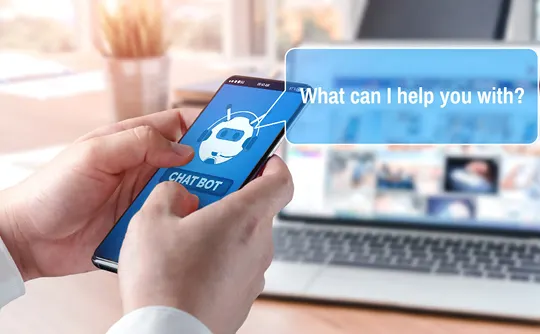
AI chatbots in healthcare are no longer futuristic. They are a present-day reality reshaping how patients engage with care providers. Unlike basic rule-based bots that follow pre-programmed scripts, AI-powered chatbots can understand context, respond dynamically, and learn over time to improve interactions. These chatbots are embedded in websites, mobile apps, EHR systems, and messaging platforms, and their core purpose is to assist patients with routine tasks and information without the need for live human intervention.
From real-time support and multilingual communication to personalized follow-ups and streamlined scheduling, these digital assistants are helping hospitals and health systems meet rising patient expectations while easing the load on clinical staff. Systems like UCHealth, Mount Sinai Health System, and Singapore General Hospital are already running live deployments that demonstrate measurable impact.
| Quick Answer : AI chatbots improve patient engagement in healthcare by providing 24/7 instant responses to routine queries, automating appointment scheduling and reminders, delivering multilingual post-discharge follow-up, and routing complex issues to clinical staff — handling thousands of interactions simultaneously without increasing headcount. Systems like UCHealth, Mount Sinai, and Singapore General Hospital are already running live deployments. |
Chatbots on messaging platforms like WhatsApp extend this reach further. Quad One’s AI WhatsApp Bot lets patients schedule appointments, retrieve reports, and get support in their own language — all within a single WhatsApp conversation, with no app downloads required.
What Is the Difference Between a Rule-Based and AI-Powered Healthcare Chatbot?
Not all healthcare chatbots are created equal. Understanding the distinction between rule-based and AI-powered chatbots is critical for healthcare leaders evaluating solutions.
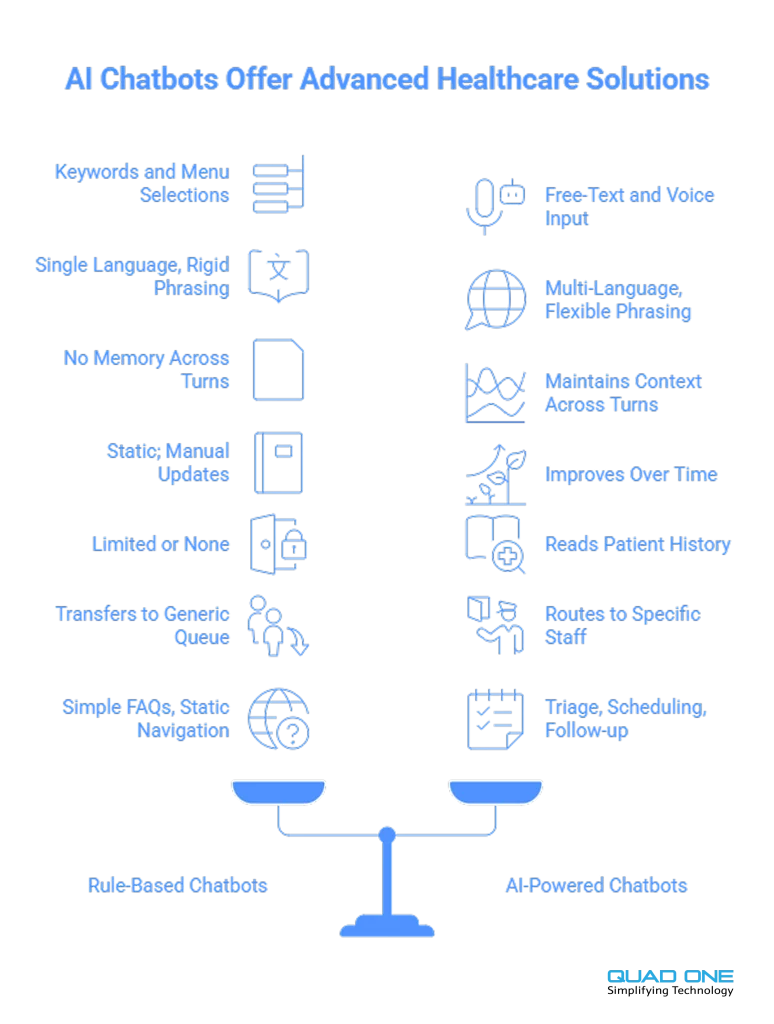
Rule-based chatbots follow pre-programmed decision trees. They respond to specific keywords or menu selections with fixed answers. They work well for simple, predictable tasks (FAQs, basic navigation) but break down when patients phrase questions in unexpected ways. They cannot learn, cannot handle ambiguity, and cannot maintain context across a multi-turn conversation.
AI-powered chatbots use natural language processing (NLP) and machine learning to understand intent, extract entities, and generate contextual responses. They handle free-text input, support multiple languages, improve over time as they process more interactions, and can escalate to human staff when they detect clinical complexity or patient distress. Modern AI chatbots can also integrate with EHR and CRM systems to personalise responses based on a patient’s history.
The practical difference: a rule-based bot might fail if a patient types “I need to see someone about my knee” instead of selecting “Orthopedics” from a menu. An AI chatbot understands the intent, maps it to the right department, checks provider availability, and offers to book.
How Do AI Chatbots Improve Patient Engagement? Core Use Cases
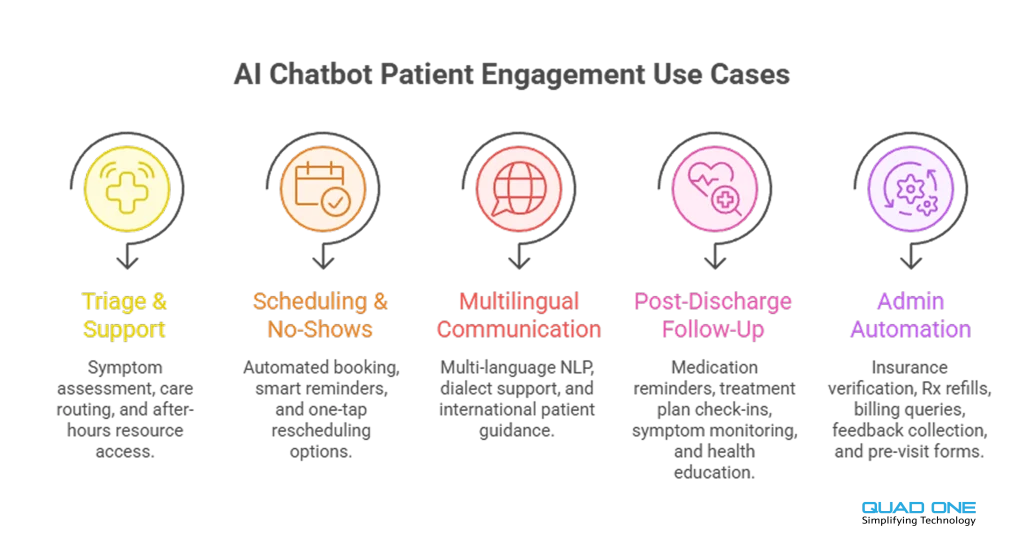
1. 24/7 Instant Support and Triage
One of the most immediate advantages of AI chatbots is their ability to provide instant, around-the-clock assistance. Patients do not have to wait for business hours or navigate phone trees. A chatbot can answer questions about symptoms, medications, billing, insurance, or hospital services at any hour. For clinical queries, AI chatbots can perform preliminary triage, assessing symptom severity and routing patients to the appropriate care level (self-care guidance, GP appointment, urgent care, or emergency).
Mount Sinai Health System deployed an AI chatbot that handles basic triage questions and connects patients to relevant resources after hours. This reduces the burden on call centres and builds patient trust by ensuring help is always available.
2. Appointment Scheduling and No-Show Reduction
AI chatbots automate appointment bookings, send smart reminders, and help reschedule when needed. UCHealth in Colorado uses a chatbot named Livi, which integrates with their My Health Connection patient portal to streamline the booking process and reduce no-show rates. Livi helps patients schedule appointments, check symptoms, and access educational resources, handling thousands of interactions per month.
3. Multilingual Patient Communication
In regions with linguistic diversity, language is a barrier to effective healthcare. AI chatbots support multiple languages and dialects, making information accessible to a wider audience. Bumrungrad International Hospital in Thailand uses AI chatbots that offer multilingual support for international patients, guiding them through registration, pre-consultation FAQs, and post-visit summaries. This level of inclusivity ensures no patient is left behind due to language limitations.
4. Post-Discharge Follow-Up and Education
Engaging patients does not end when they leave the clinic. AI chatbots can follow up on treatment plans, send personalised medication reminders, and check on symptoms. These ongoing interactions also serve as a powerful tool for education, delivering easy-to-understand information that empowers patients to take charge of their health. Singapore General Hospital employs AI chatbots in its telehealth services to screen symptoms and route patients to appropriate departments before consultations, improving response time and reducing clinical staff workload.
5. Administrative Automation
Beyond patient-facing interactions, chatbots automate high-volume administrative tasks: insurance verification, prescription refill requests, billing queries, feedback collection, and pre-visit form completion. Each of these tasks, when handled manually, consumes staff time and introduces error risk. A single AI chatbot can handle thousands of these interactions simultaneously, freeing clinical and front-desk staff for higher-value work.
Real-World Case Studies: UCHealth, Mount Sinai, and Singapore General Hospital
UCHealth (Colorado, USA)
UCHealth implemented Livi, an AI chatbot integrated with its My Health Connection portal. Originally built to help patients find locations and providers, Livi quickly evolved as patients began asking about test results, doctor messages, and health-specific questions. The chatbot now handles thousands of interactions per month, improving patient access to information and reducing administrative overhead for staff. Livi bridges the gap between patients and their digital health tools, helping them accomplish tasks faster using systems that already exist.
When chatbot interactions feed into an AI hospital CRM, every patient query becomes actionable data: appointment requests route to scheduling, symptom reports trigger care workflows, and satisfaction signals inform service recovery.
Mount Sinai Health System (New York, USA)
Mount Sinai launched a chatbot capable of answering general medical questions, guiding users to care pathways, and connecting them to telemedicine options during non-clinical hours. The chatbot handles basic triage questions and routes patients to the right resources, reducing the burden on after-hours call centres and building patient trust through always-available support.
Singapore General Hospital
Singapore General Hospital employs AI chatbots in its telehealth services to screen symptoms and route patients to appropriate departments before consultations. This method helps prioritise care needs, reduce wait times, and ensure patients are well-prepared before meeting a provider either virtually or in person. The integration of triage chatbots with telehealth has been particularly effective in managing specialist referral workflows.
These case studies share a common pattern: AI chatbots succeed when they are integrated with existing clinical systems (EHR, scheduling engines, patient portals) and when they are designed to escalate to human staff at the right moment, not replace them.
How AI Healthcare Chatbots Work: Technical Architecture
A healthcare AI chatbot operates through a pipeline that converts patient input into an actionable response:
Natural Language Processing (NLP) parses the patient’s input (text or voice-to-text), identifies intent (book, ask, cancel, report symptom) and extracts entities (provider name, date, symptom type, medication name).
Dialogue management maintains conversation context across multiple turns. If a patient asks about a test result and then says “what does that mean?”, the system understands “that” refers to the previously discussed result, not a new query.
Back-end integration connects via APIs (including FHIR where applicable) to EHR systems, scheduling engines, billing platforms, and knowledge bases. The chatbot reads real-time data (appointment availability, lab results, insurance status) and writes actions back (book appointment, create refill request, log triage outcome).
Safety and escalation logic ensures the chatbot knows its limits. When it detects clinical urgency (chest pain, suicidal ideation), ambiguity it cannot resolve, or patient frustration, it transfers to a human agent with the full conversation context attached. No cold handoff.
HIPAA compliance requires end-to-end encryption, patient identity verification before PHI access, audit logging of every interaction, and secure data storage. The chatbot vendor must sign a Business Associate Agreement (BAA).
The Future of AI Chatbots in Patient Engagement
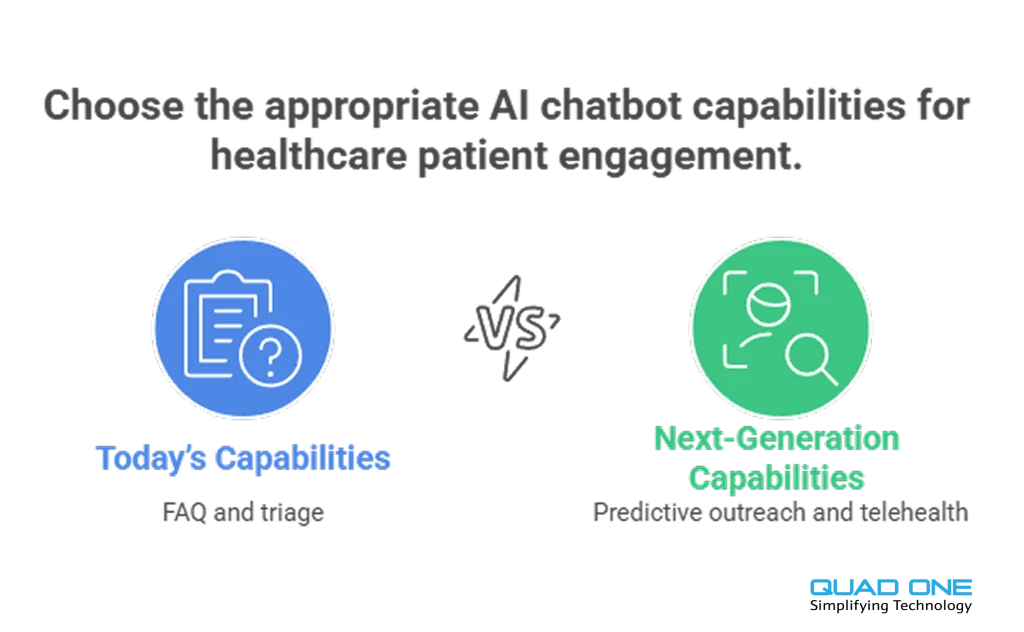
As technology continues to evolve, AI chatbots will become more predictive, more integrated, and more essential to delivering high-quality, patient-centred care. Key developments on the horizon include:
Predictive engagement. Chatbots that proactively reach out to patients based on risk signals (overdue screenings, medication non-adherence patterns, post-surgical recovery milestones) rather than waiting for patients to initiate contact.
Deeper EHR integration. Chatbots that access real-time clinical data to offer personalised, context-aware responses. A patient asking “When is my next appointment?” gets a specific answer, not a generic “Please call our office.”
Telehealth convergence. Chatbots that triage symptoms and seamlessly hand off to a live video consultation when clinical assessment is needed. Explore Quad One’s AI telemedicine solution to see how chat-to-video workflows are already operational.
Ambient listening and documentation. AI chatbots that listen to patient-provider conversations (with consent), generate structured clinical notes, and push them to the EHR, reducing documentation burden on clinicians.
Emotional intelligence. Sentiment analysis that detects patient anxiety, confusion, or frustration and adjusts conversational tone, pace, and complexity in real time.
Conclusion
AI chatbots in healthcare are not a single-use tool. They are a versatile patient engagement layer that operates across the full care continuum: from pre-visit triage and scheduling through in-visit support to post-discharge follow-up and chronic disease management. What makes them powerful is their versatility. They are equally effective in busy US health systems like UCHealth as they are in forward-thinking Asian providers like Singapore General Hospital.
For healthcare leaders looking to enhance engagement, improve operational efficiency, and support patient centered care, the time to invest in AI chatbot solutions is now.
Explore Quad One’s AI Chatbot Solutions book a demo to see how our AI-powered chatbot and WhatsApp bot connect triage, scheduling, follow-up, and patient engagement in one platform.