
As artificial intelligence systems evolve, they are no longer built as single, isolated models. Instead, modern AI solutions are increasingly composed of multiple specialized agents that work together to perform complex tasks. From enterprise automation to research assistants and intelligent monitoring systems, these agents must interact with tools, data sources, and other agents seamlessly.
However, enabling this collaboration is not straightforward. AI systems often rely on different APIs, data formats, and execution environments, which makes integration difficult and inefficient. To address this challenge, the Model Context Protocol (MCP) has emerged as a standardized framework that enables AI agents to communicate, access tools, and share context across distributed systems.
By acting as a universal interface between AI models and external services, MCP simplifies integration and enables scalable, secure, and collaborative AI architectures.
What Is a Model Context Protocol (MCP)?
The Model Context Protocol (MCP) is an open protocol designed to standardize how AI models interact with external tools, services, and data sources. It provides a consistent method for AI applications to request information, trigger functions, and exchange contextual data.
Instead of building custom integrations for every service, developers can use MCP as a shared communication layer that connects models with external capabilities. This allows AI systems to remain modular, extensible, and easier to maintain.
Problems MCP Solves for AI Agents
As AI systems grow more complex, several integration challenges begin to emerge. MCP helps address many of these issues.
One major problem is the fragmentation of tool integrations. Each new service typically requires a unique API connection, increasing development effort and maintenance overhead.
Another challenge is the lack of shared context between agents. Without a structured way to exchange contextual information, agents may duplicate work or fail to coordinate effectively.
MCP resolves these challenges by providing a structured, secure, and standardized protocol for accessing tools, managing context, and coordinating interactions between agents and services.
Why MCP Matters for Multi-Agent AI Systems
Model Context Protocol (MCP) is crucial for multi-agent AI systems as it ensures consistent and reliable context sharing between agents. Without it, communication gaps and data inconsistencies can cause inefficiencies. By enabling smooth coordination and accurate information exchange, MCP helps systems perform more effectively.
Shift to Distributed and Agentic Architectures
AI development is moving toward distributed and agent-based architectures, where different agents specialize in specific tasks. One agent may gather information, another may analyze data, while a third performs actions based on the results.
This approach improves efficiency and flexibility because each agent focuses on a defined capability. However, these agents still need a reliable way to collaborate and share information.
MCP provides the infrastructure that allows these distributed agents to interact with tools and resources in a consistent manner, enabling them to work together as part of a unified system.
Importance of Shared Context and State
For collaboration to work effectively, AI agents must maintain a shared understanding of the task and its progress. Stateless communication models often make this difficult because each interaction occurs independently.
MCP introduces stateful communication, allowing sessions to retain context across multiple interactions. This enables agents to access relevant information, track workflow progress, and respond intelligently as new data becomes available.
Maintaining shared context is particularly valuable in environments such as enterprise operations, research systems, and automated workflows where tasks evolve over time.
How Model Context Protocol (MCP) Works
MCP operates through a structured architecture that separates system responsibilities while maintaining seamless communication between components.
Core MCP Architecture:
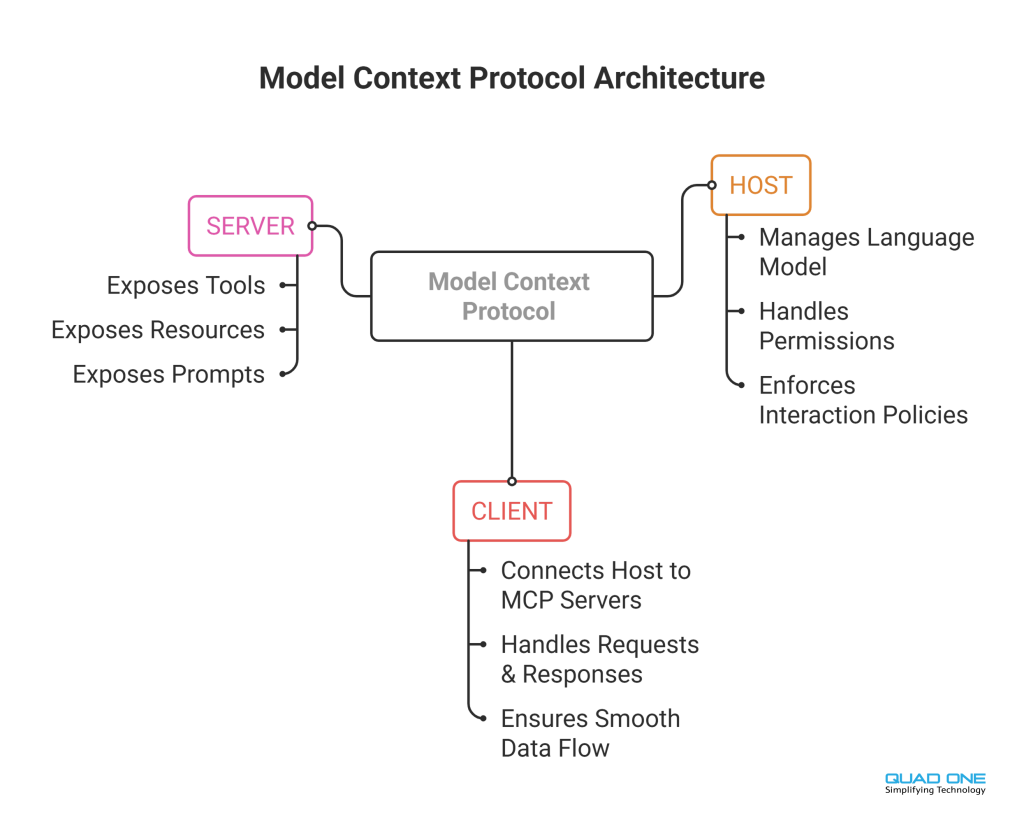
At its core, MCP uses a host-client-server structure that manages how AI models interact with tools and external systems.
This architecture allows developers to introduce new capabilities without modifying the core AI model, making systems easier to extend and maintain.
Host, Client, and Server Roles
Host : The host acts as the central controller of the AI session. It manages the language model, handles permissions, and ensures that interactions with external tools follow defined policies.
Client : The client connects the host to MCP servers. It handles requests and responses, ensuring that communication between the AI model and external services occurs smoothly.
Server : MCP servers expose capabilities that AI agents can use. These capabilities may include tools for executing functions, data resources such as files or databases, and prompt templates that guide interactions.
By separating these roles, MCP enables flexible integration and simplifies the addition of new tools.
JSON-RPC Communication Model
Communication between MCP components is typically handled through JSON-RPC, a lightweight protocol designed for remote procedure calls.
JSON-RPC allows agents to send structured requests to servers and receive standardized responses. This approach ensures predictable interactions and simplifies integration with different programming environments.
Context, Tools, and State Management
One of MCP’s most powerful features is its ability to manage context and persistent workflows. Through maintained sessions and capability negotiation, agents can retain relevant information throughout a task.
Agents can access shared resources, subscribe to updates, and invoke tools as needed, enabling continuous interaction with data sources and services.
This design allows AI workflows to operate more intelligently, adapting to new information while maintaining consistency across multiple steps.
Multi-Agent Communication with MCP
As AI systems continue to advance, the ability for multiple agents to collaborate efficiently has become essential. Model Context Protocol (MCP) supports this by enabling smooth communication between agents through a shared framework for exchanging context and information.
In multi-agent setups, different AI models or tools typically manage specific tasks, and MCP ensures each one receives the right context at the right moment. This helps minimize miscommunication, enhances coordination, and allows systems to function more seamlessly. By enabling structured and consistent interactions, MCP empowers organizations to create more intelligent, collaborative, and scalable AI environments.
Agent-to-Agent Coordination
In a multi-agent system, different agents often specialize in retrieving information, analyzing data, or executing actions. Coordinating these activities requires a communication layer that ensures agents can exchange information efficiently.
MCP enables agents to interact with shared tools and resources while maintaining clear boundaries between responsibilities. This reduces redundancy and ensures that agents collaborate effectively toward a common objective.
Orchestrating Complex AI Workflows
Many AI-driven processes involve multi-step workflows that require coordination between several agents and services. MCP provides the framework for orchestrating these workflows.
For instance, one agent may collect data from a database, another may analyze the information, and a third may trigger automated processes based on the results. By connecting these steps through MCP, organizations can build sophisticated automation systems that remain flexible and scalable.
Key Features: MCP & REST API Integration
| Feature | Model Complex Protocol(MCP) | REST API |
| Communication | Protocol designed for AI model interactions | HTTP-based request–response communication |
| State Management | Stateful, maintains session context | Stateless, each request is independent |
| Purpose | Permission-based tool | Connects applications and web services |
| Agent Collaboration | Supports multi-agent coordination | Not designed for agent collaboration |
| Context Handling | Dynamic tool and resource access | Fixed API endpoints |
| Workflow Support | Enables complex AI workflows | Best for simple service requests |
| Tool Access | Dynamic tool and resource access | Fixed API endpoints |
| Security | Permission-based tool access and isolation | Uses authentication like API keys or OAuth |
Stateful MCP vs Stateless REST
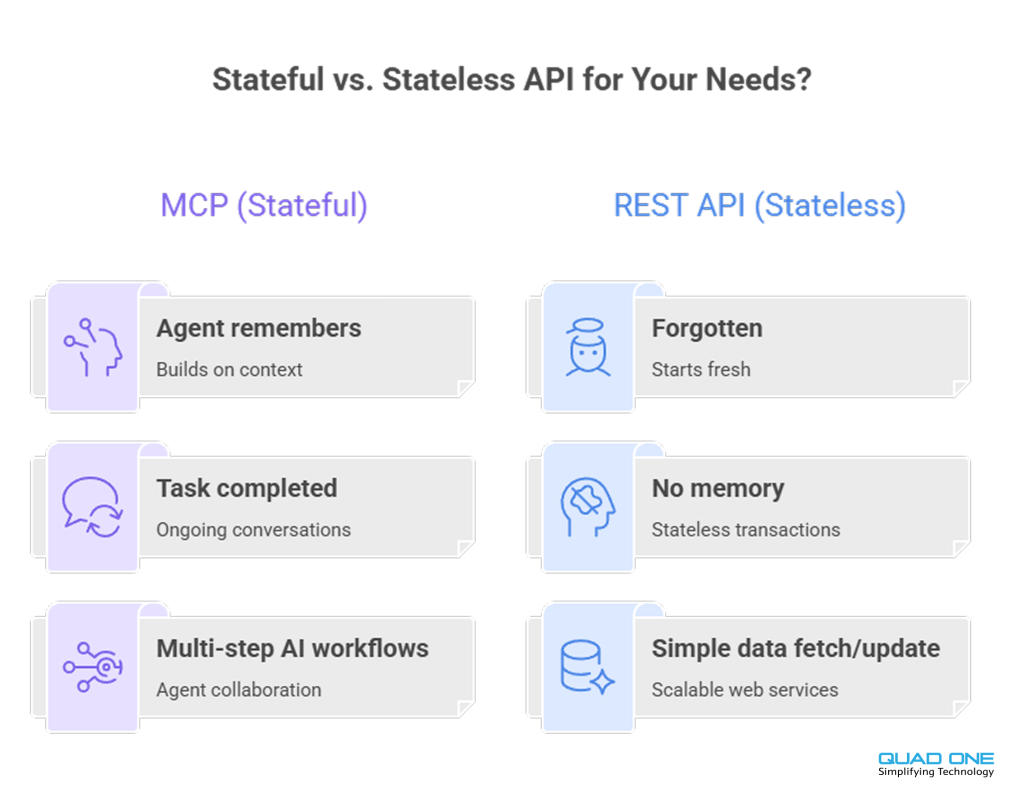
Stateful MCP (Model Context Protocol) keeps track of previous interactions between systems or AI agents. It remembers earlier messages, decisions, and shared information, so the conversation or workflow can continue smoothly. Because it stores this history, agents can understand the context better and complete multi-step tasks without repeating the same information again and again.
Stateless REST APIs, on the other hand, do not remember any past interactions. Every request is treated as a new one, so all the required information must be sent each time. This makes REST simple and scalable, but it does not naturally support ongoing conversations or workflows unless the client sends the previous context with every request.
When to Use MCP Instead of REST
MCP (Model Context Protocol) is preferred over REST when systems need to maintain context across multiple interactions or support multi-step workflows between AI agents. It allows agents to remember previous exchanges, share context, and collaborate efficiently, making it suitable for AI-driven tasks that require continuity and coordination.
REST APIs, however, work best for simple, independent operations such as fetching or updating data, where each request is processed separately without relying on previous interactions.
Real-World Use Cases of MCP
Model Context Protocol (MCP) is no longer just a theoretical idea. It is being actively used in real-world applications to build more intelligent and interconnected AI systems. As organizations adopt multi-agent setups and integrate AI across different functions, MCP ensures that context is shared accurately and consistently between systems.
Across industries like healthcare, finance, customer support, and enterprise automation, MCP helps improve coordination between tools, supports better decision-making, and enables more personalized and efficient user experiences. Looking at real-world use cases shows how MCP delivers practical value by seamlessly connecting data, systems, and AI agents at scale.
Enterprise AI Assistants
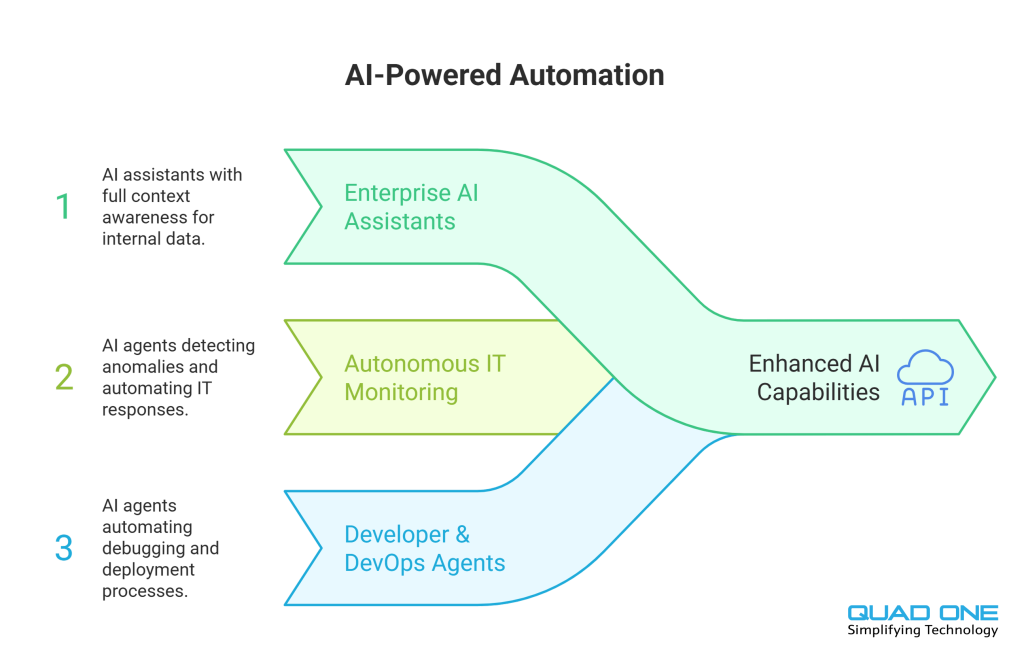
Organizations are increasingly deploying AI assistants to help employees access internal knowledge, generate reports, or automate tasks. MCP allows these assistants to securely connect with enterprise systems such as databases, documentation platforms, and analytics tools while maintaining contextual awareness throughout interactions.
Autonomous Operations and Monitoring
In IT operations and infrastructure monitoring, AI agents can detect anomalies, analyze logs, and trigger automated responses. MCP enables these agents to coordinate actions, access monitoring tools, and maintain shared context about system health and incidents.
Developer and DevOps AI Agents
AI-powered developer tools are becoming common in software engineering. MCP allows developer agents to interact with code repositories, testing systems, CI/CD pipelines, and documentation tools. This enables automated debugging, deployment assistance, and intelligent development workflows.
How to Implement Model Context Protocol (MCP)
Implementing Model Context Protocol (MCP) calls for a clear and strategic approach to ensure smooth interaction between AI systems while maintaining security, efficiency, and scalability. As organizations shift toward more connected and multi-agent AI setups, MCP acts as a key layer that enables consistent context sharing across various tools, platforms, and workflows.
Effective implementation begins with assessing the current system architecture and pinpointing where MCP can enhance data flow and system integration. It also involves defining standardized communication protocols, establishing governance frameworks, and ensuring strong data security practices. By following a structured plan, organizations can integrate MCP seamlessly and enable more dependable, context-aware AI interactions.
MCP SDKs and Setup
Many MCP implementations provide SDKs and developer tools that simplify integration. These SDKs allow developers to create MCP servers, define capabilities, and connect AI models to external services with minimal configuration.
Connecting Models, Tools, and Data
Implementing MCP typically involves defining the tools, resources, and data sources that AI agents can access. MCP servers expose these capabilities, allowing agents to request data, trigger actions, or retrieve information as part of a workflow.
Security and Access Control
Security is an essential part of MCP deployment. Permissions should be carefully configured to ensure that agents only access approved tools and resources. Role-based access control and auditing mechanisms can further strengthen system security.
MCP Limitations and Challenges
While Model Context Protocol (MCP) provides a solid framework for smooth communication between AI systems, it also has certain limitations and challenges. As organizations implement MCP in more complex and distributed setups, they may face difficulties with scaling, integrating with existing systems, and keeping context consistent across multiple agents.
Integration is a key challenge in MCP, as aligning it with legacy systems, diverse data sources, and third-party tools can be complex and time-consuming. Maintaining consistent context across multiple agents, along with managing data security, latency, and governance, further adds to the difficulty. Without proper monitoring, clear policies, and strong infrastructure, these issues can affect the overall effectiveness of MCP.
Security and Prompt Injection Risks
Because MCP enables models to interact with external tools and systems, it also introduces potential security risks. Malicious prompts or poorly validated inputs could attempt to trigger unintended actions. Proper input validation and access controls are necessary to reduce these risks.
Complexity and Performance Trade-offs
While MCP improves flexibility and collaboration, it can also introduce additional architectural complexity. Maintaining state, coordinating agents, and managing context across systems may increase computational overhead compared to simpler REST-based architectures.
Best Practices for Using MCP
To ensure the effective and compliant use of Model Context Protocol (MCP) in AI-driven systems, organizations should follow a set of well-defined best practices. These not only improve operational efficiency but also strengthen security, scalability, and interoperability across systems.
As AI systems grow more complex and spread across multiple platforms, MCP becomes essential for keeping context consistent throughout different workflows. Without clear structures in place, organizations may run into problems like inconsistent data, miscommunication between systems, or potential security risks. By putting standardized protocols and proper governance in place, businesses can ensure that interactions between AI agents remain reliable, transparent, and aligned with their overall goals.
Designing Minimal and Secure Context
To maintain efficiency and security, systems should only share the essential context required for a task. Limiting unnecessary data exchange reduces risk and improves performance.
Building Scalable Agent Architectures
Designing agents with clear responsibilities improves scalability and maintainability. Each agent should focus on a specific capability, while MCP manages coordination and communication between them.
Conclusion
As AI systems evolve toward multi-agent and distributed architectures, the need for standardized communication frameworks becomes increasingly important. The Model Context Protocol provides a powerful solution by enabling AI agents to securely access tools, share context, and collaborate across complex workflows.
By simplifying integration and supporting stateful interactions, MCP allows organizations to build scalable and intelligent AI systems that go beyond isolated models. While challenges such as security and system complexity remain, following best practices can help teams effectively leverage MCP to power the next generation of AI-driven applications.