The healthcare industry continues to evolve rapidly, driven by technological advancements that aim to enhance patient care, optimize operational workflows, and improve the financial health of healthcare organizations. Among these technological breakthroughs, artificial intelligence (AI) is playing an increasingly transformative role, particularly in medical coding.
As we have already in mid-2025, AI-powered tools are reshaping the way healthcare organizations approach medical coding, billing, and revenue cycle management. This article examines how AI is transforming medical coding, the key technologies driving this transformation, and the implications for healthcare professionals, administrators, and organizations.
What is Medical Coding?
Medical coding is the process of translating healthcare diagnoses, procedures, medical services, and equipment into universal medical codes. These codes are used for various purposes, including billing, insurance claims, and maintaining patient records. Medical coding plays a crucial role in ensuring healthcare providers receive proper reimbursement for their services and that all healthcare data is standardized and accessible for research and regulatory purposes.
Medical coding is primarily based on standardized coding systems such as:
- ICD-10: International Classification of Diseases, 10th Edition, used to code diagnoses.
- CPT: Current Procedural Terminology, used for coding medical procedures and services.
- HCPCS: Healthcare Common Procedure Coding System, used for coding medical equipment and services.
These coding systems are updated regularly to reflect new medical procedures, treatments, and diagnoses. However, manually reviewing and assigning the correct codes to clinical documentation can be time-consuming and prone to errors. With the rise of AI, medical coding is experiencing a transformation that improves accuracy, speed, and efficiency in these critical tasks.
AI-Powered Medical Coding Technologies
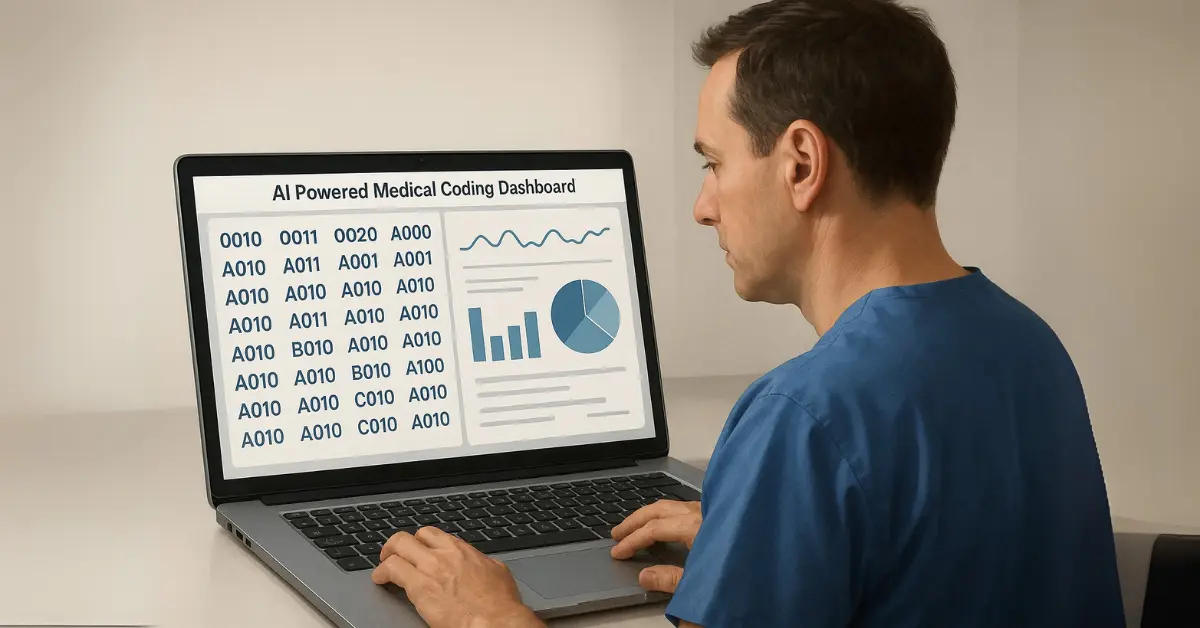
AI-powered medical coding technologies use machine learning to automate the assignment of standardized codes (like ICD-10 and CPT) to patient diagnoses, procedures, and treatments. By analyzing clinical notes, EHRs, and billing data with high accuracy, they reduce errors, speed up reimbursements, ensure compliance, and free coders for complex tasks boosting efficiency in healthcare revenue cycles.
Natural Language Processing (NLP) in Medical Coding
One of the most powerful applications of AI in medical coding is Natural Language Processing (NLP). NLP is a branch of AI that enables machines to comprehend, interpret, and produce human language in a manner that is both meaningful and contextually accurate. In the context of medical coding, NLP is utilized to process and extract relevant information from unstructured clinical data, including physician notes, discharge summaries, and electronic health records (EHRs).
NLP medical coding tools can automatically scan patient records and translate clinical language into standardized codes, significantly reducing the need for manual coding. This not only increases efficiency but also minimizes human error, a common issue in traditional coding methods. The integration of NLP into coding workflows enhances coding compliance, reduces administrative burdens, and ensures that medical billing is accurate and up-to-date with the latest regulations.
Computer-Assisted Coding (CAC)
Another AI-powered technology transforming medical coding is Computer-Assisted Coding (CAC). CAC systems use AI algorithms to analyze clinical documentation and suggest appropriate medical codes based on the data. These systems serve as a form of support for human coders, offering coding suggestions and enhancing coding accuracy. They streamline the process by assisting coders in selecting the correct ICD-10 and CPT codes, which helps eliminate human error while speeding up the entire coding workflow.
CAC tools often integrate with EHR systems and revenue cycle management (RCM) platforms, ensuring a seamless flow of information across healthcare organizations. With the ability to process vast amounts of data in real time, CAC enhances coding productivity, reduces claim rejections, and optimizes revenue cycle management.
Machine Learning and Predictive Analytics in Coding
Machine learning (ML) is another AI technology that has great potential in medical coding. Unlike traditional algorithms that are programmed with specific instructions, ML systems can learn from data over time, improving their predictive capabilities as they are exposed to more clinical data.
In the context of medical coding, machine learning algorithms are trained to recognize patterns in clinical data and predict the most likely codes based on historical coding patterns and clinical guidelines. For example, predictive analytics coding can anticipate and prevent coding errors before they occur, reducing claim denials and ensuring that accurate codes are submitted in a timely manner.
By continuously analyzing past coding data, ML tools can offer real-time suggestions and even predict the likelihood of specific codes being accepted by insurers, helping healthcare organizations avoid costly rework and delays.
The Benefits of AI in Medical Coding
AI in medical coding delivers key benefits: faster processing with 90%+ accuracy, fewer errors in code assignment from clinical data, quicker reimbursements and revenue cycles, stronger compliance with regulations like HIPAA, and cost savings by automating routine tasksallowing human coders to tackle complex cases and improve overall healthcare efficiency.
Improved Accuracy and Reduced Errors
AI-driven medical coding tools, particularly those powered by NLP and ML, offer substantial improvements in accuracy compared to traditional manual coding methods. By automating the coding process, AI tools significantly reduce the risk of human error, ensuring that codes are more precise and compliant with the latest regulations.
For example, AI systems can cross-reference coding rules and guidelines in real-time, ensuring that coders select the correct codes based on the latest ICD-10 or CPT code updates. This level of precision is particularly crucial in high-stakes areas, such as coding compliance, where errors can result in claim denials, delayed reimbursements, or even legal penalties.
Enhanced Revenue Cycle Optimization
The integration of AI into medical coding processes also contributes to better revenue cycle optimization. With AI-powered coding solutions, healthcare organizations can submit claims more quickly and accurately, reducing the time between service delivery and payment. This leads to faster reimbursement and improved cash flow.
AI also plays a crucial role in denial management, a common challenge in healthcare billing. By analyzing historical claim data and identifying patterns of claim rejections, AI tools can provide insights into potential coding mistakes that may lead to denials. This proactive approach allows coders and billing teams to make adjustments before submitting claims, improving the likelihood of claim acceptance.
Healthcare Cost Reduction
By automating the medical coding process and reducing the reliance on manual labor, AI in medical coding contributes to significant cost savings for healthcare organizations. The reduction in coding errors results in fewer claim denials, less rework, and fewer delays in reimbursement, all of which can lead to reduced administrative overhead and improved operational efficiency.
Furthermore, AI’s ability to analyze clinical data in real time can help identify inefficiencies in coding workflows, leading to streamlined processes and greater cost reduction in the long run. This is particularly important in an era of value-based care, where healthcare organizations are under increasing pressure to deliver high-quality care while controlling costs.
Real-World Applications of AI in Medical Coding
AI in medical coding powers practical tools like automated code suggestions during clinical documentation, where systems scan physician notes in real-time to recommend ICD-10 and CPT codes, cutting coding time from 15-20 minutes to under 5 per encounter. It’s used for error detection by cross-checking diagnoses against lab results and procedures, reducing claim denials and audit risks. Other applications include EHR integration for accurate multi-diagnosis matching, real-time feedback for coders, and multilingual support for global hospitals handling diverse patient data.
AI Integration with Electronic Health Records (EHRs)
Many healthcare organizations are already benefiting from the integration of AI-powered coding tools with their existing EHR systems. By embedding AI into the EHR, medical coding is seamlessly integrated into the clinician’s workflow. When clinicians enter patient data, AI-powered systems automatically suggest relevant codes, ensuring accurate and compliant coding that meets the latest standards.
Case Studies in AI-Driven Medical Coding
Several healthcare providers have implemented AI-driven medical coding systems with positive results. For example, major hospitals in the United States and Europe have reported a significant reduction in claim denials and coding errors after adopting AI-powered CAC and NLP tools. These organizations have also noted improvements in the speed of claim submissions, ultimately enhancing their revenue cycle management.
The Future of AI in Medical Coding: Challenges and Opportunities
AI will automate routine coding by 2030 while humans handle complexity, but faces HIPAA compliance, bias risks, and upskilling needs. Opportunities include faster revenue cycles and strategic coder roles.
Overcoming Regulatory and Compliance Challenges
As AI technologies in healthcare continue to evolve, regulatory bodies must ensure that AI-powered coding systems comply with existing coding standards, such as ICD-10, CPT, and HCPCS codes. Additionally, AI systems must be rigorously tested and validated to ensure that they produce accurate and reliable coding results.
Training and Adaptation for Medical Coders
While AI can significantly enhance coding processes, human coders will continue to be essential for handling complex cases that require clinical judgment. The future of medical coding will likely involve greater collaboration between AI and human coders. Training healthcare professionals to work effectively with AI tools will be crucial for maximizing the benefits of these technologies.
Conclusion
AI is undeniably transforming the field of medical coding, providing healthcare organizations with powerful tools to improve accuracy, optimize revenue cycles, and reduce administrative costs. As AI continues to evolve, the integration of NLP, machine learning, and predictive analytics will further revolutionize the medical coding process, driving efficiencies and helping healthcare organizations meet the challenges of an increasingly complex healthcare environment.
For medical coders, Health Information Management (HIM) professionals, and healthcare executives, embracing AI-powered medical coding technologies presents a unique opportunity to stay ahead of the curve in an industry undergoing rapid digital transformation in healthcare. With the potential to enhance coding compliance, reduce errors, and streamline revenue cycle management, AI is shaping the future of medical coding. Healthcare organizations that adopt these technologies will be well-positioned for success in 2025 and beyond.